Glossary
Adaptive Efficiency
Ang identifies two key gaps in Douglass North’s concept of Adaptive Efficiency, including his focus on control.
Adapt vs. Change
Adaptation refers to a particular type of change in which agents fit themselves to changing environments through mechanisms such as variation and selection, whereas other forms of change—such as shocks or aging—do not involve adaptation.
Gradual Institutional Change
Gradual institutional change does not necessarily equal evolution, as gradual change can occur without adaptive mechanisms.
Margins of the Establishment
Margins of the establishment is a positionality concept to describe being situated close enough inside elite institutions to know how they operate, yet far enough to perceive their blind spots and exclusions.
Directed Improvisation: United States as Demonstration
Directed Improvisation: United States as Demonstration refers to Yuen Yuen Ang’s use of twentieth-century U.S. innovation policy as a comparative reference point, showing that directed improvisation is not unique to China.
Coevolutionary Development: United States as Demonstration
Coevolutionary Development: United States as Demonstration refers to Yuen Yuen Ang’s use of 19th-century U.S. development to show how the economy and fiscal capacities coevolved through improvisation and crisis-driven adaptation.
Coevolutionary Development: Nigeria as Demonstration
Coevolutionary Development: Nigeria as Demonstration refers to Yuen Yuen Ang’s use of Nigeria to illustrate how markets can emerge through informal, normatively weak arrangements in the absence of strong state capacity.
Directed Improvisation: China as Demonstration
Directed Improvisation: China as Demonstration refers to Yuen Yuen Ang’s use of reform-era China (1980s-2012) to empirically demonstrate the model of Directed Improvisation: top-down direction + bottom-up improvisation = diverse coevolutionary paths.
Directed Improvisation
Directed Improvisation is a model for enabling collective creativity that combines top-down direction with bottom-up improvisation.
Uncertainty vs. Risk
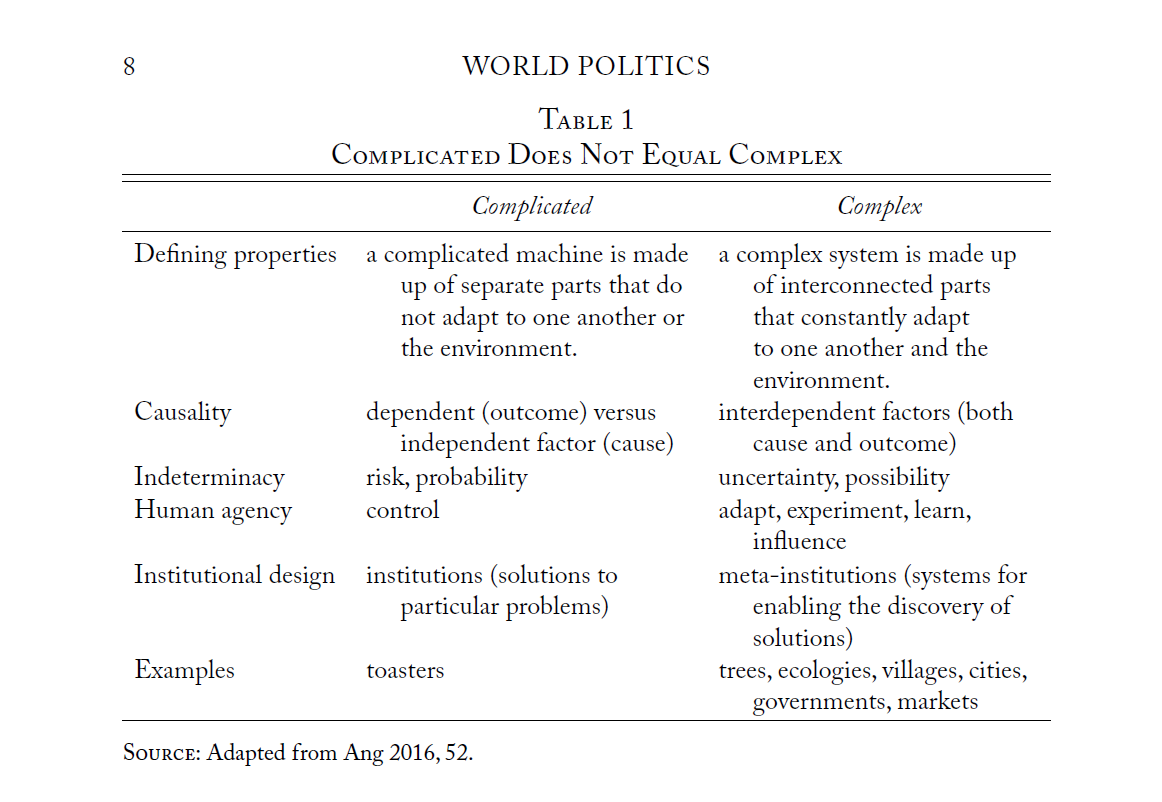
Yuen Yuen Ang defines uncertainty as open-ended possibilities—both good and bad—that cannot be known in advance, whereas risk means negative outcomes that can be calculated and controlled
Influence vs. Control
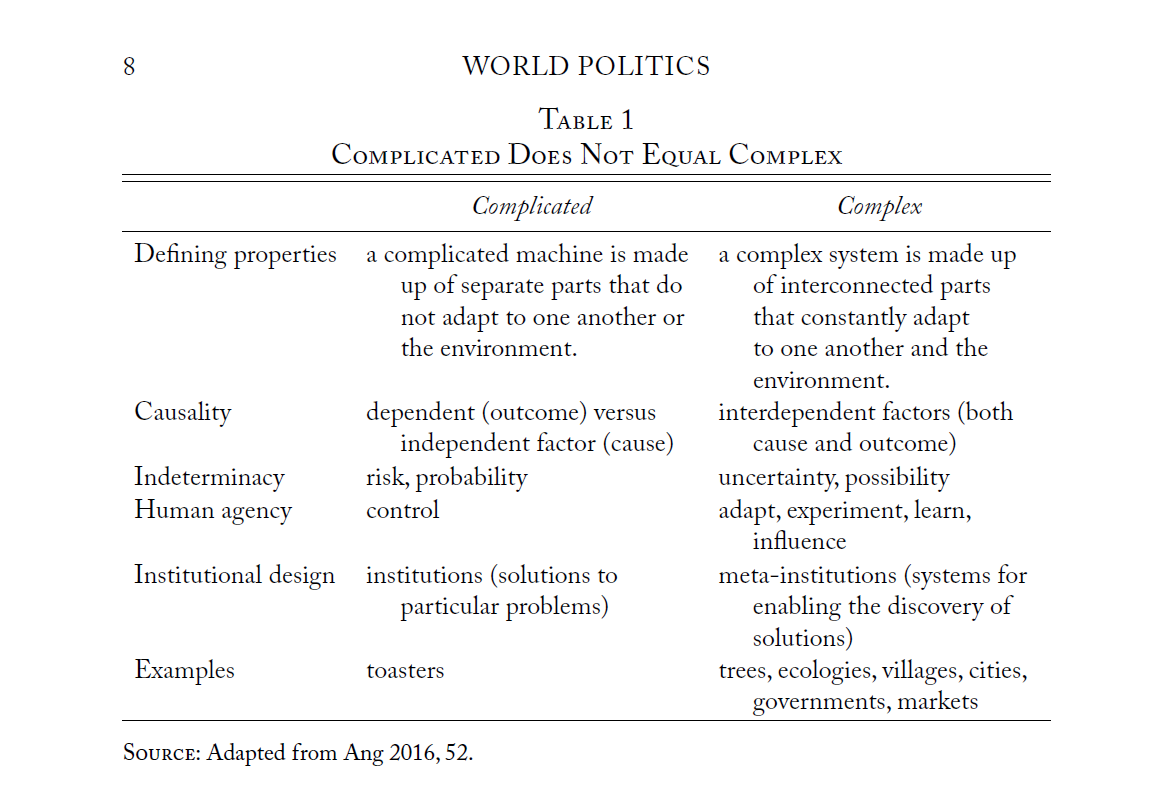
Influence vs. Control is a conceptual distinction articulated by Yuen Yuen Ang to differentiate appropriate modes of action in complex versus complicated settings.
Normatively Weak, Functionally Strong
Normatively Weak, Functionally Strong captures the idea that institutions or practices judged “weak,” “wrong,” or “backward” by first-world normative standards may nonetheless function effectively at early stages of development.
Stage-Variant Institutions
Stage-Variant Institutions posits that institutional forms and strategies that work at one stage of development may not work at another.
Market-Building vs. Market-Preserving
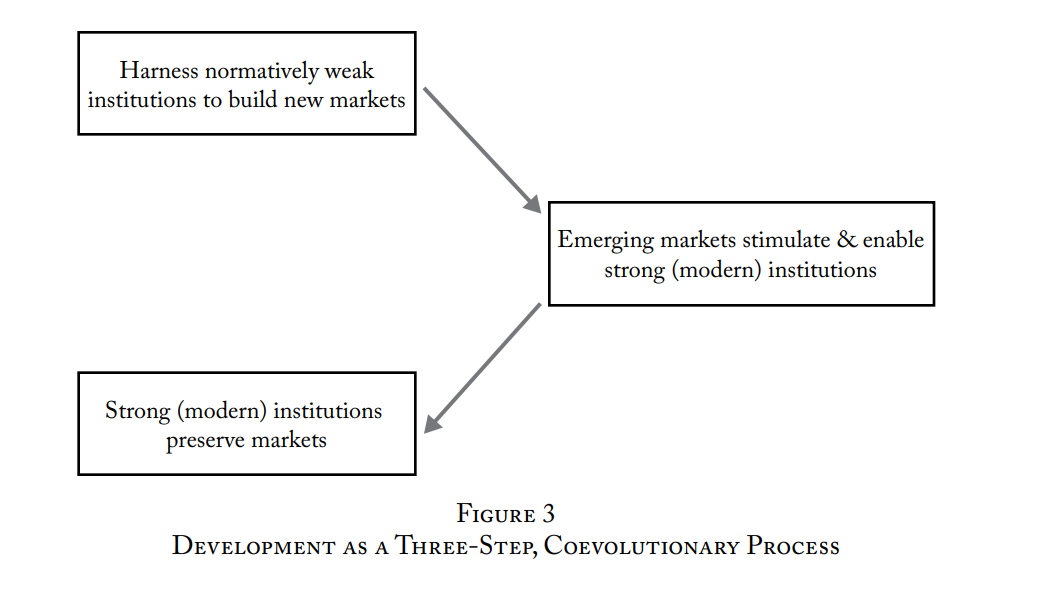
Market-Building vs. Market-Preserving is a stage-variant concept coined by Yuen Yuen Ang to distinguish institutions or approaches that create new markets from those that preserve established markets.
Mapping Coevolution
Mapping Coevolution is a qualitative method for tracing and modeling endogenous (bicausal) processes of mutual change between two or more domains over time.

Coevolutionary Development: China as Demonstration
Coevolutionary Development: China as Demonstration explains China’s development as a coevolutionary process in which the economy, society, and political institutions mutually adapt over time.
Coevolutionary Development
Coevolutionary Development explains political-economic development as a non-linear (mutually adaptive) process in which the economy, governance, or institutions evolve together over time, rather than in a linear sequence.
Chicken-and-Egg Fallacy of Development [Endogeneity]
Chicken-and-egg fallacy of development refers to a circular reasoning (endogeneity) problem in which economic growth is said to require good institutions, while good institutions are said to require economic growth.
Complex
Complex describes systems made up of many interconnected parts that interact with and adapt to one another and to their environment—such as trees.
Complicated
Complicated describes machine-like objects made up of many separate parts whose operations are linear, decomposable, and controllable—such as a toaster.