
Polytunity names a moment of global disruption in which crisis and possibility coexist.
What defines the times in which we live? 2025 was a special year. For mathematicians, it was a “perfect square” year: 45 X 45 - a rare symmetry. For future historians, it marked the expiration of the postwar world order, and the imminent birth of a new one.
After World War II, the victorious Western allies built a system intended to prevent another catastrophic conflict. That system rested on three intertwined promises: geopolitical stability anchored by American leadership, industrial progress that would raise living standards, and globalization that would spread prosperity through trade and integration.
That postwar order delivered real achievements. But it also carried the seeds of its own demise. Authority was concentrated within Western-led institutions that claimed to speak for the world, and US hegemony slid into overreach and hubris. Globalization entrenched a lopsided bargain: low-cost manufacturing in poor countries encouraged consumption among consumers in rich ones, but at a global environmental cost. As production moved overseas, local communities in the West lost jobs. And financialization made it easier to accumulate wealth through speculation and asset inflation, enriching the richest without delivering social value.
The viral meme “polycrisis” describes the breakdown of this old order. But it fails to diagnose their root causes, validating fear but obscuring responsibility. It also frames Western shocks as global threats, while overlooking the agency of the rest of the world.
Rather than simply naming the death of the old, we must ask what might replace it. When everything seems to break down at once, we’re forced to go beyond patchwork solutions and redesign systems from the ground up. That is why we should view this moment not as a polycrisis, but as a polytunity – a generational opening for global transformation from the margins.
Polytunity is the portal—the opening—into Yuen Yuen Ang’s intellectual forest because her central question is precisely this: When the old operating system fails—geopolitically, economically, and intellectually—what new system should replace it? What assumptions and principles should we begin with? What new voices should be heard?
These challenging questions take us to the response: AIM (Adaptive, Inclusive, Moral Political Economy).
Polytunity
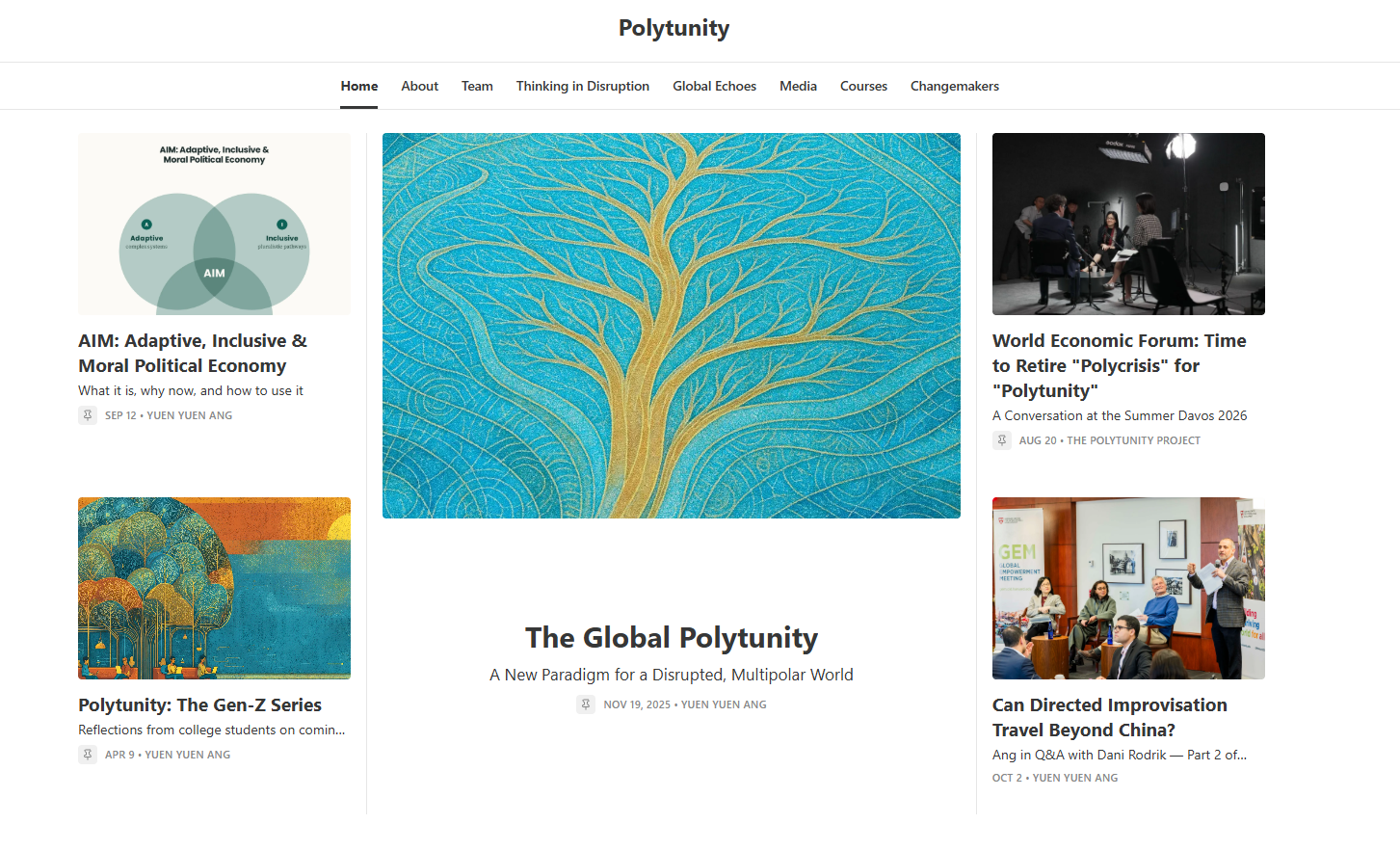
Connect at Polytunity on Substack, an intellectual hub and course page
With updates, thinking tools, contributions from global partners, interviews, student applications, and a forthcoming Changemakers series.
Interview at Davos
“From Polycrisis to Polytunity: The Future of Geopolitics,” with Robin Romeroy & Olivia Siong
“I am proposing that we should flip that term [polycrisis], because the idea of a polycrisis is, frankly, fear-driven and paralyzing.
The idea of polytunity comes from a certain realism… The realist in me tells me that a time of global breakdown can be scary for some, but it is also a rare opportunity for deep reflection and transformation.
If you think about it, in normal times we don’t like to make big changes. It’s hard, it’s risky, so we continue with business as usual no matter how broken things are.
Sometimes we actually need to be forced to change.”