Coevolutionary Development: China as Demonstration
Term
Coevolutionary Development: China as Demonstration
Citable Version (DOI): http://dx.doi.org/10.2139/ssrn.6147186
Idea Level
Application: Development
Definition
Coevolutionary Development: China as Demonstration is a theory first introduced by Yuen Yuen Ang in How China Escaped the Poverty Trap (2016) that explains China’s development as a coevolutionary process in which the economy, society, and political institutions mutually adapt over time, rather than by first establishing “good governance” that conforms to Western standards.
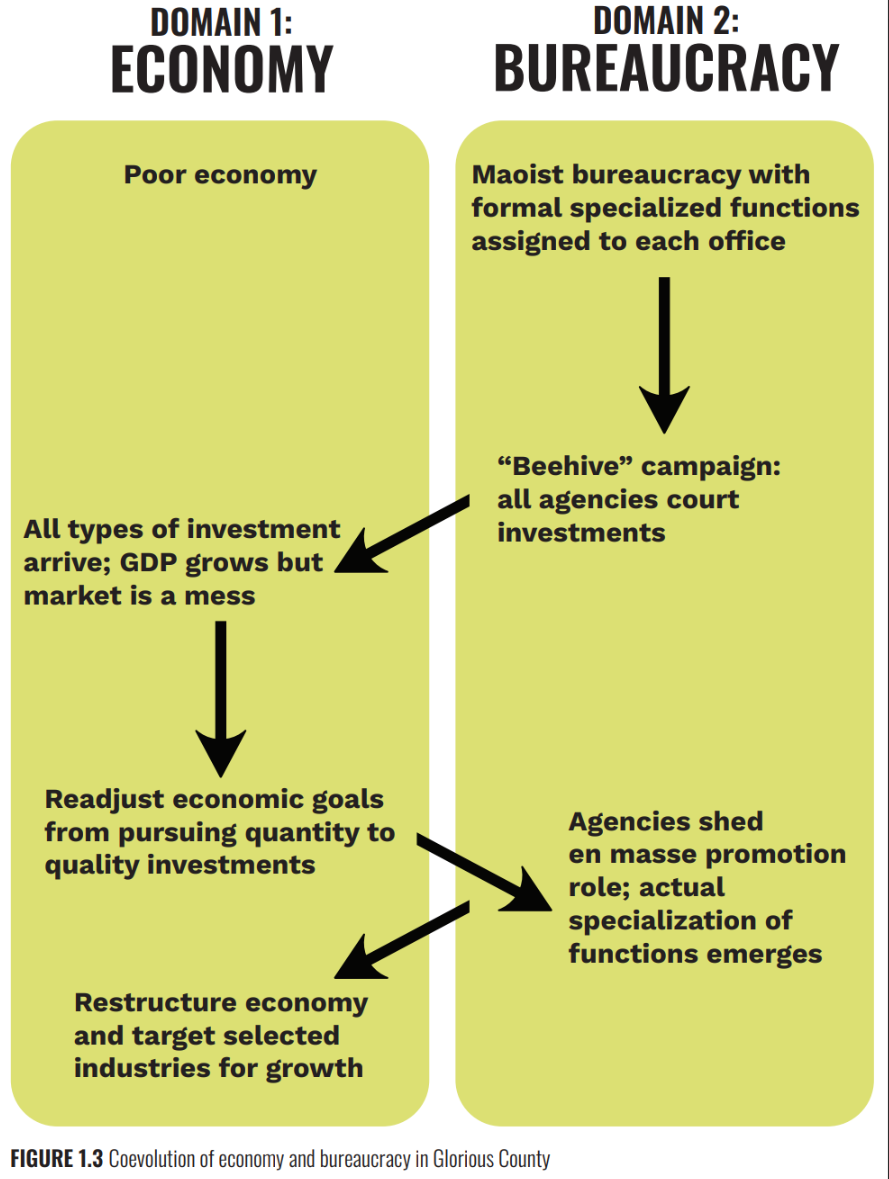
Ang demonstrates her theory of Coevolutionary Development using reform-era China (1980s–2012) as a high-resolution empirical case, tracing how state–market relations coevolved across regions and sectors—including economic structure, property rights, development strategies, bureaucratic incentives, and corruption.
Definition of “Coevolutionary Development” (generic theory)
Coevolutionary Development is a theory developed by Yuen Yuen Ang in 2016 that explains political-economic development as a non-linear (mutually adaptive) process in which the economy, governance, or institutions evolve together over time, through zig-zag causal chains, rather than in a linear sequence.
Ang has demonstrated this theory across cases and historical periods: China, Europe, Nigeria, and the United States.
Sources
Empirical demonstration:
Ang, Y.Y. (2016) How China Escaped the Poverty Trap, Chapters 5 and Chapter 6 (China at national and subnational levels); Chapter 7 (cross-national comparison).
Theoretical synthesis:
Ang, Y.Y. (2015) “Do Weberian Bureaucracies Lead to Markets or Vice Versa? A Coevolutionary Approach to Development.” In States in the Developing World (2017).
Ang, Y.Y. (2024) “Adaptive Political Economy: Toward a New Paradigm.” World Politics.
Public lectures (selected):
Ang, Y.Y. “The Real China Model: What Other Developing Countries Should Learn from China.” UNDP-Cambodia. 23 Aug 2018. (See UN press release for video lecture and slides)
Ang, Y.Y. (2024) “Let Many China Models Bloom.” Episode 3, The Economics of China.
Genealogy
[Paradigm] AIM (Adaptive, Inclusive, Moral Political Economy)
→ [Pillar] Adaptive Political Economy (APE)
→ [Pillar] Inclusive: multiple development pathways within China, not convergence to a single Western template
→ [Theory] Coevolutionary Development
→ [Application: Development] China as demonstration (national and subnational): traced coevolution of markets, property rights, development strategies, bureaucratic incentives, and corruption
Quotes
[Chicken-and-egg problem / circular causation] This is a study about how development actually happens. Is it really the institutions of good governance that launch markets? Or is it growth that enables good governance? Or is history destiny? My answer begins with a simple observation: development is a coevolutionary process. States and markets interact and adapt to each other, changing mutually over time.
As [the conventional] logic goes, we must first turn weak institutions into strong institutions that approximate those found in rich countries before it is possible to pursue growth. This logic then becomes entangled in a chicken-and-egg problem of how we can obtain strong institutions if growth is lacking in the first place. My comparative analysis of coevolutionary paths across contexts points to way out of vicious cycles of poverty and weak state capacity: make creative use of whatever is available.
— Ang, How China Escaped the Poverty Trap (2016), Introduction (p. 3) and Chapter 7 (p. 243)
[Method: Mapping Coevolution] My empirical approach generates multiple snapshots of reciprocal feedbacks between states and markets… When these snapshots are strung in sequence… depending on when (which year) and when (coastal or inland) we look in China, there is evidence for a whole variety of competing explanations for successful reforms: developmental vs. minimalist states, private vs. collective property rights, orthodox vs. unorthodox institutions [that is, no single, fixed China model].
If by “model” we mean a set of characteristics that are consistent over space and time, then none of these particular features make up the China model… Rather, what is consistent over time and across space in reform-era China is the adaptive approach of directed improvisation.
— Ang, How China Escaped the Poverty Trap (2016), Introduction (pp. 12-14) and Conclusion (p. 239)
[Sectoral analysis: coevolution of property rights and economy] I will trace the coevolution of the structure of property rights and markets over three phases: (1) Prior to 1993, the assignment of partial property rights to collective enterprises; (2) After 1993, informal property rights protection through personal relationships between bureaucracy and businesses; (3) From 1998 onward, state efforts to formally protect private property and rein in bureaucratic predation.
— Ang, How China Escaped the Poverty Trap (2016), Chapter 5 (p. 142)
[Sectoral analysis: coevolution of state institutions and economy] I propose an alternative—coevolutionary—theory of the relationship between states and markets… I will demonstrate its explanatory utility by applying it to the mutual emergence of professional bureaucracies and state-led industrial growth in local governments in China. Reform-era China provides an especially instructive case because within the span of a single generation, China has undergone remarkable transformation.
— Ang, Do Weberian Bureaucracies Lead to Markets or Vice Versa? (2017), pp. 282-283
[Directed Improvisation / No single fixed China model] Deng [China’s reform-era leader] crafted a set of conditions that empowered primarily local state but also market actors to pursue development adaptively. It is these ground-level actors who improvised numerous particular solutions to continuously changing problems, specific to their locale and income level, thereby fueling a coevolutionary process of development. These adaptive responses interacted with an unequal distribution of growth opportunities and endowments across regions, producing a variety of subnational coevolutionary paths. While some like Blessed County sped ahead economically and institutionally, others like Humble County lagged behind. These divergent trajectories of change spilled into one another and cumulated to revolutionize the entire political economy.
— Ang, How China Escaped the Poverty Trap (2016), Chapter 7 (p. 240)
[Theoretical synthesis of 2016 book] Development analysts have long struggled with a chicken-and-egg problem. Which comes first in development, growth or good institutions? In the temple of political economy, authoritative economists and political scientists have occupied different pedestals on this question [modernization theory; institutional economics; historical institutionalism]… They all make straight-line arguments… Despite a dazzling concentration of intellectual prowess, all three schools failed to find a way out of the chicken-and-egg problem. Why? Because they took an inherently endogenous (bicausal) process—economic and institutional development—and forced it to fit within their linear, static models.
In its most distilled form, development is best understood as a three-step, coevolutionary process:
Step 1: Harness normatively weak institutions to build new markets.
Step 2: Emerging markets stimulate and enable strong (modern) institutions.
Step 3: Strong (modern) institutions preserve markets.
— Ang, Adaptive Political Economy (2025)
Concept Constellation
Across Ang’s work, Coevolutionary Development: China consistently co-appears with the following concepts and analytic themes:
Chicken-and-Egg Fallacy of Development (problem)
Mapping Coevolution (method)
Market-Building vs. Market-Preserving / Stage-Variant Institutions (mechanism)
Normatively Weak, Functionally Strong (mechanism)
Directed Improvisation: China (meta-institutionenabling adaptation)
Many “China Models” within China (outcome)
Coevolutionary Development: Nigeria, United States (Ang’s theory applied beyond China)
Coevolutionary Development as application of Adaptive Political Economy
Summary Figure