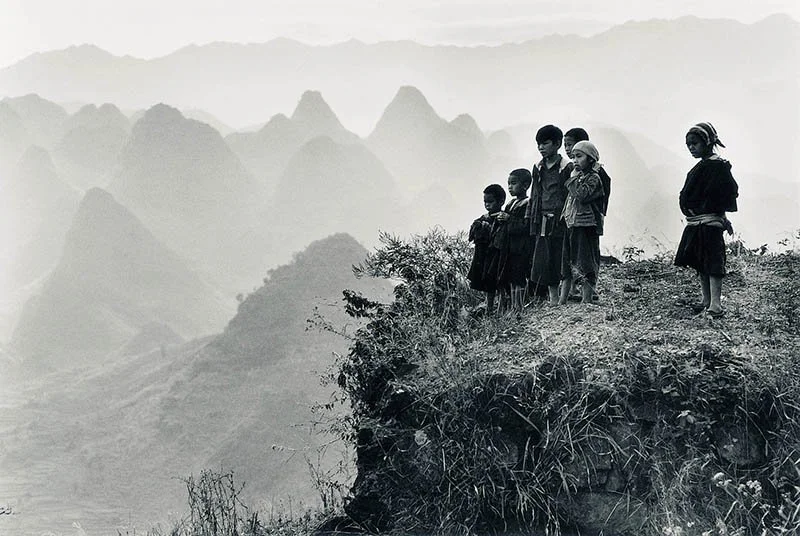
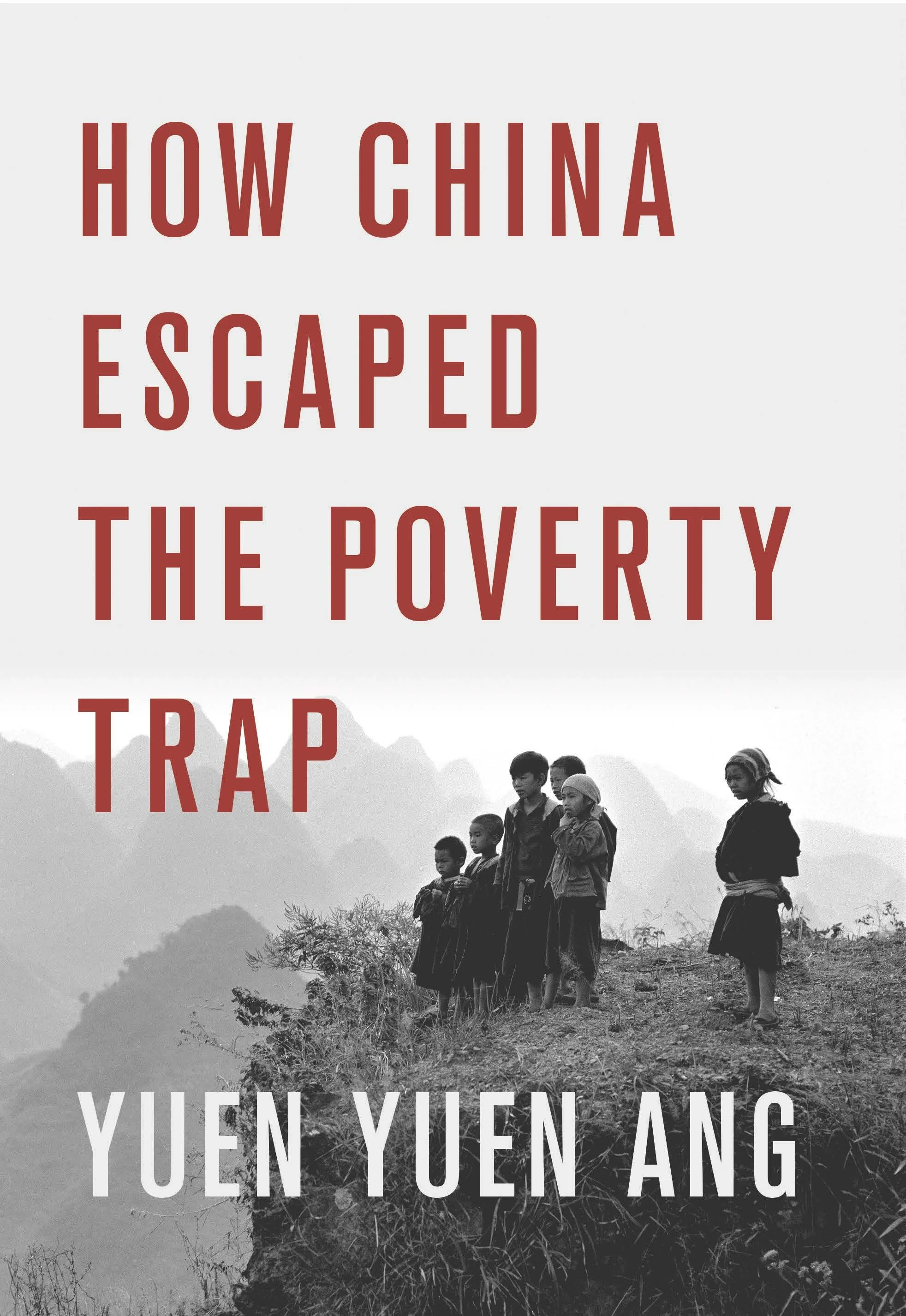
How China Escaped the Poverty Trap
Now available open access. Download the e-book free at Cornell University Press or by chapter at JSTOR.
“How China Escaped the Poverty Trap truly offers game-changing ideas for the analysis and implementation of socio-economic development and should have a major impact across many social sciences.”
“Theoretically, [Ang’s] systematic engagement with diverse literatures circumvents disagreement over which came first, democracy or development, to make a field-shifting move to non-linear complex processes.”
“This book is a triumph, opening a window onto the political economy of China’s astonishing rise that takes as its starting point systems and complexity. Its lessons apply far beyond China’s borders.”
“While adaptive approaches to development have become new buzzwords, Yuen Yuen's work brings rigor to this conversation.... This analytical lens has enormous potential for thinking through the adaptive challenge, whether at the national level, subnational level or sectoral level.”
“Unlike traditional books that follow Western models.. This book will change how you think about progress, institutions, and how countries can grow on their own terms. It is not just about China instead it is a guide for all developing nations.”
Lata Sharma, Indibloggers (India)
“The lesson is not that Nigeria should imitate China. It is that transformation begins when a society recovers the confidence to act within its own realities.”
Chidinma Linda Obi, Nextier (Nigeria)
Awards & Recognition
How China Escaped the Poverty Trap received the Peter Katzenstein Prize in Political Economy and the Viviana Zelizer Prize in Economic Sociology. It was recommended by The Economist in “Five Books on Ending Poverty” (22 July 2022), alongside the Nobel-winning economists Amartya Sen; Abhijit Banerjee & Esther Duflo; Daron Acemoglu, Simon Johnson & Jim Robinson.
From the book, an essay explaining how China rose without Western-style democracy was named Best of Print by Foreign Affairs.
-
Awarded by American Sociological Association in 2018 | See past Zelizer Prize winners
In How China Escaped the Poverty Trap Yuen Yuen Ang offers a bold and innovative framework for understanding economic development, one that challenges current wisdom from modernization and institutionalist perspectives. The later, she argues, are simply too linear, top-down and errantly predicated on inductive modelling from Western contexts that make little sense for the global south. She founds her alternative in complexity theory; envisioning economic development as a recursive and dynamic process in which state and markets co-evolve through innovation that cannot be prescribed.
Ang both theorizes and demonstrates how this process is bootstrapped using weak institutions at all levels of governance. Developmental paths are formed through what she terms directed improvisation, the process by which the state sets some clear makers for policy makers at lower levels, but otherwise provides incentives and support to use local knowledge and experimentation. This allows for necessary variation across the economic landscape and in different industries, the capacity for bureaucrats and entrepreneurs to select novel combinations of strategies, and the pursuit of niche economies that provide for virtuous growth cycles with ramifications for the larger economy.
In a series of richly detailed case studies Ang demonstrates how success was nurtured when goals were initially narrow and institutional transformation broad but gradual, when bureaucrats at all levels were incentivized to become entrepreneurial stakeholders, and when the boogie of corruption is harnessed to build momentum.
She carefully analyzes these dynamics at the macro-, meso- and micro-levels. Through these case studies Ang additionally examines how the unleashing first of the coastal economies provided for cascading effects on their inland counterparts. She is also sensitive to how this co-evolutionary process produces systemic problems with respect to the environment and inequality. To add depth through comparison she also applies her model to disparate cases such as medieval Europe, the antebellum post-depression United States and Nigeria’s Nollywood film industry.
How China Escaped the Poverty Trap truly offers game-changing ideas for the analysis and implementation of socio-economic development and should have a major impact across many social sciences.
*****
YYA: With heartfelt thanks to the late Prof. Marc Steinberg, Chair of the Zelizer Prize Committee. Though we never met, and never will, I feel a profound connection with him. I am deeply and forever grateful for his recognition of this book.
-
The Katzenstein Prize, in honor of Peter J. Katzenstein, the Walter S. Carpenter, Jr. Professor of International Studies at Cornell University, recognizes an outstanding first book in International Relations, Comparative Politics, or Political Economy. It was awarded in 2017.
In How China Escaped the Poverty Trap, Yuen Yuen Ang offers a revisionist theoretical framework that grapples with complexities of institutional adaptation alongside detailed analyses of sub-national variation in development outcomes. In contrast to conventional wisdom that good governance is a requisite for ameliorating poverty, she points out how weak institutions can, at times, allow for innovations in the development of markets.
Thus Ang’s project contributes to multiple debates, including but not limited to China. Theoretically, her systematic engagement with diverse literatures circumvents disagreement over which came first, democracy or development, to make a field-shifting move to non-linear complex processes.
How China Escaped the Poverty Trap goes far beyond saying context matters to show how non-linear processes are simultaneously place-specific in their manifestations (e.g. China) yet general (to a wide range of contexts). In addition, Ang’s research offers an exemplar of how to move beyond methodological nationalism through attention to sub-national variation.
Beyond area specialists, anyone concerned with institutions, development, or the role of China in the world, should read this elegantly written book.
See the list of awardees here
-
The Economist, “Five Books on Ending Poverty” (22 July 2022), named along with 1998 Nobelist Amartya Sen; 2019 Nobelists Abhijit Banerjee & Esther Duflo; 2024 Nobelists Daron Acemoglu, Simon Johnson & Jim Robinson, and William Easterly.
“The enduring drag of weak institutions on a country’s development might imply pessimism. Such thoughts can be dispelled by considering the example of China, which has lifted nearly 800m people out of poverty in the past four decades or so. Yuen Yuen Ang, a political scientist, attributes China’s remarkable transformation to a “co-evolutionary” process, where markets and institutions interact and evolve together. China exploited institutional weaknesses, such as corruption and unstable property rights, to build markets. For instance local government officials were encouraged to take a cut from any growth they helped generate. (Ms Ang dives deeper into the role of graft in growth in a subsequent book [China’s Gilded Age, also reviewed in The Economist].) These flourishing markets helped strengthen institutions which in turn developed markets further. Underpinning this process was the concept of “franchised decentralisation” which gave local officials incentives to constantly innovate.”
-
Named in 2017, see the full list of winners, along with a review by Prof. Andrew Nathan
“Are there lessons in the Chinese miracle for other countries that want to surge from deep poverty to advanced development in a matter of decades? Surveying the experience of three Chinese counties, Ang cuts through the usual debate about whether good governance or economic growth should come first, seeing a more cyclical process at work.
First, authorities allowed markets to emerge even though they were hampered by corruption, weak property rights, and underregulation. Market activity then generated problems that required officials to build stronger institutions, which in turn fostered the further development of markets. Given China’s vastness, this process could unfold only because local officials were incentivized to innovate constantly, no matter the risk—a process Ang labels “franchised decentralization.”
China’s transformation in recent decades cannot be attributed to a single cause; rather, it arose from a contingent, interactive process—Ang calls it “directed improvisation.” She formalizes this insight by using a novel analytic method that she terms “coevolutionary narrative,” which has the potential to influence future studies of institutional and economic change beyond China. The Chinese system has proved to be remarkably agile, but creative adaptation is not an easy lesson for others—or even present-day China—to apply.
The process can become bogged down, which might be happening in China today, as President Xi Jinping presses the country’s bureaucrats to carry out even riskier reforms.”
-
For Ang’s essay “Autocracy with Chinese Characteristics: Beijing’s Behind-the-Scenes Reform” (adapted from How China Escaped the Poverty Trap)
See the Best of Print in 2018
“Since opening its markets in 1978, China has in fact pursued significant political reforms—just not in the manner that Western observers expected. Instead of instituting multiparty elections, establishing formal protections for individual rights, or allowing free expression, the CCP has made changes below the surface, reforming its vast bureaucracy to realize many of the benefits of democratization—in particular, accountability, competition, and partial limits on power—without giving up single-party control.
Although these changes may appear dry and apolitical, in fact, they have created a unique hybrid: autocracy with democratic characteristics. In practice, tweaks to rules and incentives within China’s public administration have quietly transformed an ossified communist bureaucracy into a highly adaptive capitalist machine.
But bureaucratic reforms cannot substitute for political reforms forever. As prosperity continues to increase and demands on the bureaucracy grow, the limits of this approach are beginning to loom large…
What broader lessons on democracy can be drawn from China? One is the need to move beyond the narrow conception of democratization as the introduction of multiparty elections. As China has shown, some of the benefits of democratization can be achieved under single-party rule.
Allowing bureaucratic reforms to unfold can work better than trying to impose political change from the outside, since over time, the economic improvements that the bureaucratic reforms generate should create internal pressure for meaningful political reform. This is not to say that states must delay democracy in order to experience economic growth. Rather, China’s experience shows that democracy is best introduced by grafting reforms onto existing traditions and institutions—in China’s case, a Leninist bureaucracy. Put simply, it is better to promote political change by building on what is already there than by trying to import something wholly foreign.
- Excerpted from Ang 2018, pp. 39-40 and 45
INET Video Lecture
What exactly is the “China Model”? In this video lecture, produced by the Institute for New Economics (INET), Ang introduces:
Directed Improvisation → Top-down direction + bottom-up improvisation = diverse coevolutionary paths within China, varying across space and evolving over time
“Deng [China’s reform-era leader] crafted a set of conditions that empowered local state and market actors to pursue development adaptively… [who] improvised numerous particular solutions to continuously changing problems, fueling a coevolutionary process of development. These adaptive responses interacted with an unequal distribution of endowments across regions, producing a variety of subnational coevolutionary paths… These divergent trajectories of change spilled into one another and cumulated to revolutionize the entire political economy.”
— How China Escaped the Poverty Trap, p. 240
Glossary