Coevolutionary Development
Term
Coevolutionary Development
Idea Level
Theory
Definition
Coevolutionary Development is a theory developed by Yuen Yuen Ang in 2016 that explains political-economic development as a non-linear (mutually adaptive) process in which the economy, governance, or institutions evolve together over time, through zig-zag causal chains, rather than in a linear sequence.
Mechanisms and Sequential Logic
This theory specifies a three-step coevolutionary process:
Step 1: Harness normatively weak institutions to build new markets.
Step 2: Emerging markets stimulate and enable strong (modern) institutions.
Step 3: Strong (modern) institutions preserve markets.
Ang’s theory distinguishes between institutions or approaches needed to build new markets from those later preserve them. [See Market-Building vs. Market-Preserving] It also distinguishes between institutions in developing societies that look wrong by Western standards (normatively weak) from the functions they may serve at a start-up stage (functionally strong). [See Normatively Weak, Functionally Strong]
In How China Escaped the Poverty Trap (2016), Ang demonstrated the theory of coevolutionary development across cases and historical periods: China, Europe, Nigeria, and the U.S.
Sources
First articulation and empirical demonstrations:
Ang, Y.Y. (2016) How China Escaped the Poverty Trap (see Excerpt “How Did Development Actually Happen?”), Chapter 1 (theoretical model and method of mapping coevolution); Chapter 5 (case study: Forest Hill City); Chapter 6 (case study: Blessed vs. Humble County); Conclusion (comparative applications to Europe, the U.S., and Nigeria); Appendix A: Steps for Mapping Coevolution.
Theoretical synthesis:
Ang, Y.Y. (2024) “Adaptive Political Economy: Toward a New Paradigm.” World Politics.
Genealogy
[Paradigm] AIM (Adaptive, Inclusive, Moral Political Economy)
→ [Pillar] Adaptive Political Economy (APE)
→ [Theory] Coevolutionary Development
→ [Method] Mapping Coevolution: specifies steps for mapping coevolution (Appendix A) and accompanying data collection strategy (Appendix B)
→ [Application: Development] Comparative and historical demonstrations across China, Europe, the U.S., and Nigeria
Contrast with
[Paradigm] Industrial–Colonial Paradigm
→ [Pillar] Mechanical thinking (linear causality)
→ Chicken-and-egg fallacy of development
→ [Application: Development] False root cause debates on “growth first” vs. “good institutions first”
Quotes
[Zigzag causal chain] My first task is to develop a method for systematically mapping the coevolution of states and markets… My empirical approach generates multiple snapshots of reciprocal feedbacks between states and markets. When these snapshots are strung in sequence, it reveals a causal logic that integrates and yet departs sharply from the conclusions of conventional theories.
[Snapshots vs. zigzag chain] Most accounts of successful development are linear causal stories, usually of something done right followed by spectacular growth. For example, political economists invoke the case of England after the Glorious Revolution in 1688 as evidence that formal limits on state power led to capitalist success… They capture only snapshots of long zigzag paths, zooming in on one causal direction.
— Ang, How China Escaped the Poverty Trap (2016), Conclusion (p. 222)
[What zigzag causal chain reveals] A coevolutionary causal chain makes clear what the study of development has critically missed. The third step of ‘strong institutions preserve markets’ has been firmly established by North and Weingast, Acemoglu and Robinson, among other leading political economists. The second step of ‘markets stimulate strong institutions’ constitutes the domain of modernization theory. By comparison, with few exceptions, we know woefully little about the first step of the causal chain: build markets with normatively weak institutions. Even less is known about how these three essential steps connect in sequence. These are the gaps I seek to fill through a coevolutionary approach to development.
— Ang, How China Escaped the Poverty Trap (2016), Introduction (pp. 11-12)
[Normatively weak, functionally strong] In other words, normatively weak institutions can be functionally strong. Perhaps the one thing poor countries possess in abundance are institutions perceived as weak or strong by first-world standards… Normally, we believe that the way out of poverty traps is to ‘quickly’ replace such weak institutions with strong institutions that define advanced industrialized economies. This book points to a different path. It illuminates the development potential that may lie hidden within institutions and local knowledge that people within developing societies already possess.
— Ang, How China Escaped the Poverty Trap (2016), Introduction (p. 8)
[Process-tracing method] Coevolutionary narratives with teeth strive to reveal mutual causal influences between two (or more) domains of interest: for example, how a particular bureaucratic adaptation affects the economy, how subsequent economic changes feedback to the bureaucracy, so on and on, in a zigzag causal chain.
— Ang, How China Escaped the Poverty Trap (2016), Mapping Coevolution (pp. 24-25)
[Coevolution of property rights & markets] Defying expectations, China’s economy took off despite the absence of private property rights and rule of law… I will trace the coevolution of the structure of property rights and markets over three phases: (1) prior to 1993, the assignment of partial property rights to collective enterprises; (2) after 1993, informal property rights protection through personal relationships between bureaucracy and businesses; (3) from 1998 onward, state efforts to formally protect private property, promote the private sector, and rein in bureaucratic predation.
— Ang, How China Escaped the Poverty Trap (2016), Chapter 5 (p. 153)
[Comparative demonstrations] Development is a coevolutionary process, not only in China but also in other parts of the world and in recent and historical periods… I revisit segments of history in the rise of the West from a coevolutionary perspective… Next, I apply the coevolutionary approach to analyze the unlikely boom of the film industry in Nigeria since the early 1990s, also known as Nollywood. Despite vastly different circumstances and institutional innovations, we find a consistent pattern of economic and institutional coevolution.
— Ang, How China Escaped the Poverty Trap (2016), Conclusion (p. 222)
[State-market coevolution in three steps] What common pattern do we see? In its most distilled form, development is best understood as a three-step, coevolutionary process: Step 1: Harness normatively weak institutions to build new markets. Step 2: Emerging markets stimulate and enable strong (modern) institutions. Step 3: Strong (modern) institutions preserve markets.
— Ang, Adaptive Political Economy (2024)
Concept Constellation
Across Ang’s work, Coevolutionary Development consistently co-appears with the following concepts and analytic themes:
Adaptive: Adapt vs. Change / Variation, Selection & Niche Creation (mechanisms of adaptation)
Inclusive: Market-Building vs. Market-Preserving / Stage-Variant Institutions (differentiating stages)
Moral: Normatively Weak, Functionally Strong (correcting normative blind spot)
Chicken-and-Egg Fallacy of Development (problem)
Mapping Coevolution (process-tracing method)
Directed Improvisation (Meta-Institution that Enables Adaptation)
[Compare external terms]
Gradual Institutional Change (Thelen & Mahoney)
Adaptive Efficiency (Douglass North)
Complexity and Development (Owen Barder)
Summary Figure
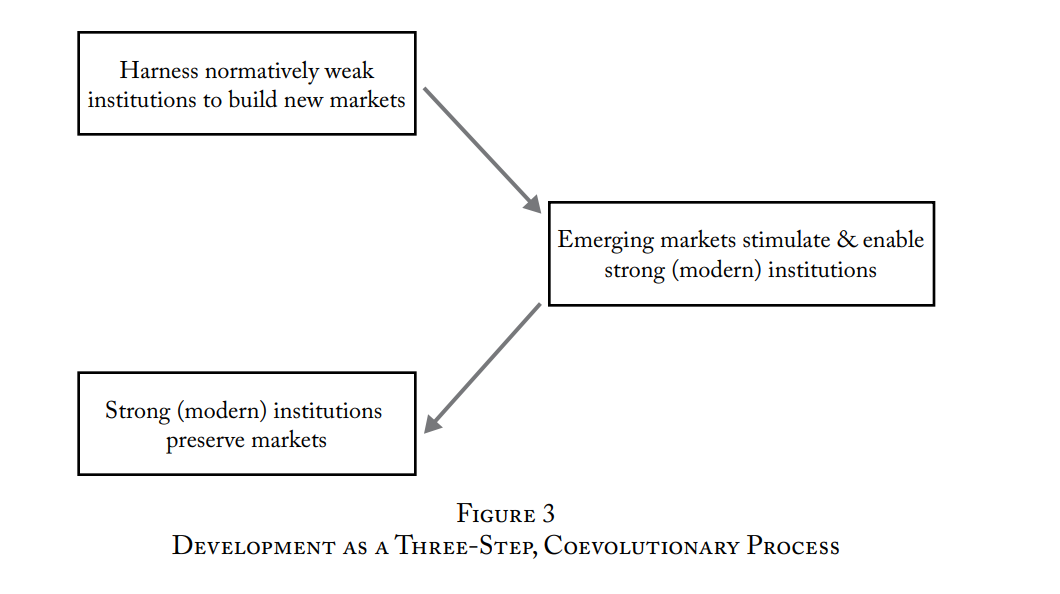
Development as a Three-Step, Coevolutionary Process
Source: “Adaptive Political Economy,” p. 13