Glossary
Coevolutionary Development: Nigeria as Demonstration
Coevolutionary Development: Nigeria as Demonstration refers to Yuen Yuen Ang’s use of Nigeria to illustrate how markets can emerge through informal, normatively weak arrangements in the absence of strong state capacity.
Directed Improvisation: China as Demonstration
Directed Improvisation: China as Demonstration refers to Yuen Yuen Ang’s use of reform-era China (1980s-2012) to empirically demonstrate the model of Directed Improvisation: top-down direction + bottom-up improvisation = diverse coevolutionary paths.
Directed Improvisation
Directed Improvisation is a model for enabling collective creativity that combines top-down direction with bottom-up improvisation.
Uncertainty vs. Risk
Uncertainty vs. Risk is a conceptual distinction articulated by Yuen Yuen Ang to differentiate the nature of indeterminacy in complex versus complicated settings.
Influence vs. Control
Influence vs. Control is a conceptual distinction articulated by Yuen Yuen Ang to differentiate appropriate modes of action in complex versus complicated settings.
Normatively Weak, Functionally Strong
Normatively Weak, Functionally Strong captures the idea that institutions or practices judged “weak,” “wrong,” or “backward” by first-world normative standards may nonetheless function effectively at early stages of development.
Stage-Variant Institutions
Stage-Variant Institutions posits that institutional forms and strategies that work at one stage of development may not work at another.
Market-Building vs. Market-Preserving
Market-Building vs. Market-Preserving is a stage-variant concept coined by Yuen Yuen Ang to distinguish institutions or approaches that create new markets from those that preserve established markets.
Mapping Coevolution
Mapping Coevolution is a qualitative method for tracing and modeling endogenous (bicausal) processes of mutual change between two or more domains over time.

Coevolutionary Development: China as Demonstration
Coevolutionary Development: China as Demonstration explains China’s development as a coevolutionary process in which the economy, society, and political institutions mutually adapt over time.
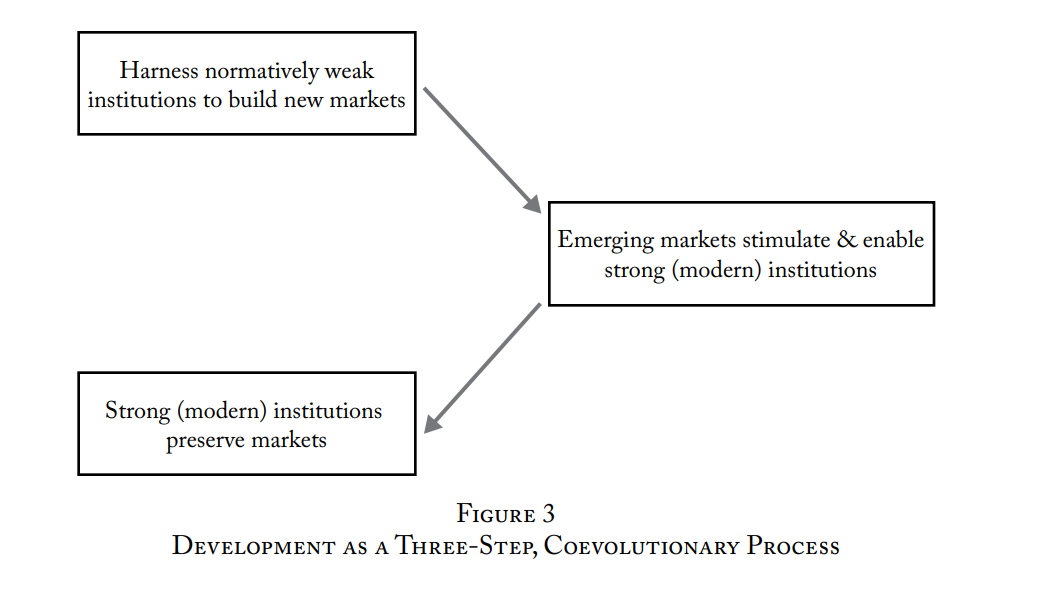
Coevolutionary Development
Coevolutionary Development explains political-economic development as a non-linear (mutually adaptive) process in which the economy, governance, or institutions evolve together over time, rather than in a linear sequence.
Chicken-and-Egg Fallacy of Development [Endogeneity]
Chicken-and-egg fallacy of development refers to a circular reasoning (endogeneity) problem in which economic growth is said to require good institutions, while good institutions are said to require economic growth.
Complex
Complex describes systems made up of many interconnected parts that interact with and adapt to one another and to their environment—such as trees.
Complicated
Complicated describes machine-like objects made up of many separate parts whose operations are linear, decomposable, and controllable—such as a toaster.
Mechanical Thinking
In Yuen Yuen Ang’s critique, mechanical thinking is ill-suited to complex societies because it strips away the inherent realities of multiple causation, feedback loops, and emergence.
Polycrisis
In Yuen Yuen Ang’s analysis, while polycrisis names the convergence of crises, it does not diagnose their root causes or provide solutions.
Industrial-Colonial Paradigm
Industrial–Colonial Paradigm describes the dominant worldview that emerged in the eighteenth century alongside industrialization and colonial expansion and continues to shape political economy into the early twenty-first century.
World Order After 2025
Yuen Yuen Ang interprets the World Order After 2025 not as polycrisis or great-power dominance, but as polytunity—a generational opening for deep transformation of global institutions and thought within a multipolar context.
Fairy Tales of Western Development
Fairy Tales of Western Development is a decolonizing critique of idealized narratives that attribute Western development primarily to political liberalism or “good institutions.”
Adaptive Fiscal Capacity
Adaptive Fiscal Capacity refers to the ability of a government to generate, manage, and adapt its portfolio of financial resources—tax and taxless alike—in response to evolving conditions.