Complexity & Development
Term
Complexity & Development
Citable version (DOI): http://dx.doi.org/10.2139/ssrn.6550541
Idea Level
Others (global development policy discourse)
Definition
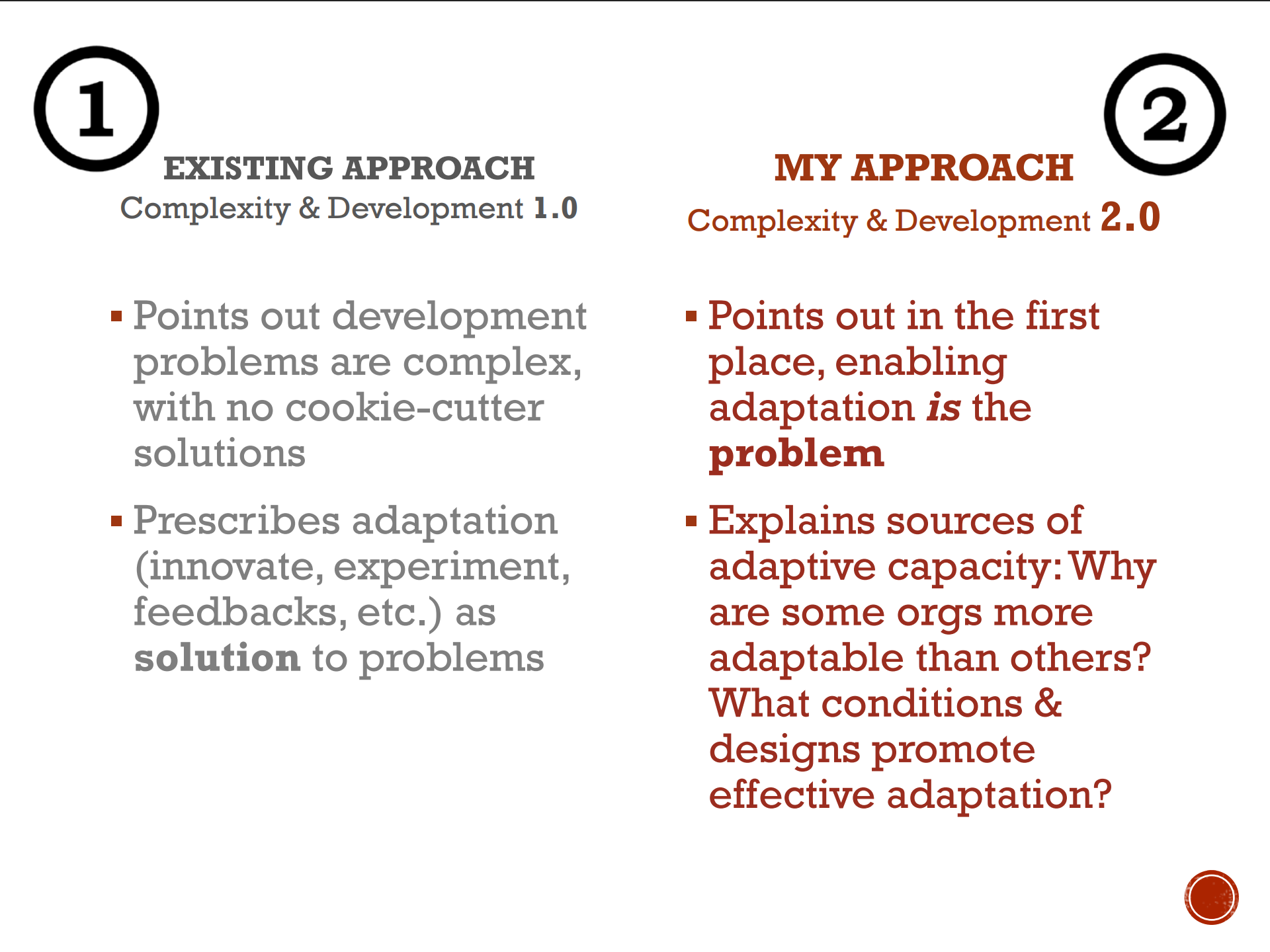
In Yuen Yuen Ang’s critique and analysis, Complexity and Development, as an emerging development policy agenda, should move beyond prescribing adaptation as a panacea or offering platitudes (e.g., “promote innovation” or “be tentative”). Ang identifies a critical gap: explaining how to enable adaptation in the first place.
To ground the agenda rigorously and empirically, she advances a further step—Complexity and Development 2.0—which examines what conditions or designs make effective adaptation possible.
Examples from Ang’s work include Meta-Institutions, Directed Improvisation, and Coevolutionary Development.
Summary Figure
Sources
Theoretical & empirical foundation:
Ang, Y.Y. (2016) How China Escaped the Poverty Trap, Introduction; Chapter 2: Directed Improvisation; Conclusion.
Ang, Y.Y. (2024) "Adaptive Political Economy: Toward a New Paradigm." World Politics.
Policy-facing communication:
Ang, Y.Y. (2018) "Complexity & Development 2.0." Presentation at Institute of Development Studies.
Ang, Y.Y. (2018) "3 Fallacies of Embracing Complexity." UNDP Transformation Series, 12 Jun 2018.
Ang, Y.Y. (2025) "Turning Polycrisis into Polytunity." UNDP Expert Brief.
Genealogy
[Paradigm] Industrial–Colonial Paradigm
→ [Pillar] Mechanical Thinking: treats development as a machine-like problem
→ [Critique] Complexity and Development 1.0: correctly rejects cookie-cutter solutions, but often stops at platitudes like “promote innovation”—without explaining how
Contrast with
[Paradigm] AIM (Adaptive, Inclusive, Moral) Political Economy
→ [Pillar] Adaptive Political Economy (APE)
→ [Concept] Enabling Adaptation: the central problem is how to create conditions for effective adaptation
→ [Mechanisms] Variation, Selection & Niche Creation
→ [Concept] Meta-Institutions (as compared to institutions as fixed rules)
→ [Application] Directed Improvisation: empirical demonstration in reform-era China
→ [Iteration] Complexity & Development 2.0: translate theory and findings into policy-relevant insights
Quotes
[Critique: Adapting is easier said than done] Normally we are inclined to think about adaptation itself as the solution to all problems. Thus popular literature readily invokes buzzwords from complexity and adaptation to accessorize slogans: ‘Embrace experimentation! Muddle through purposively! Promote innovation! Celebrate diverse solutions! And above all, don’t fear change!’
Although adaptation is universally desirable, people often fail to adapt, and even if they try they may still fail. Experimentation and muddling through may not produce useful solutions or indeed any solution. Bottom-up participation may degenerate into shouting matches and gridlock, as is sometimes seen in democratic settings. And if promoting innovation were easy, then we would all have done it long ago, and all our problems would have been magically solved.
Obviously, it is easier said than done to adapt and to adapt effectively.
— Ang, How China Escaped the Poverty Trap, pp. 15–16
[Critique: Adaptation cannot be achieved through moral pledges] In recent years, there has been an encouraging shift away from ‘best practices’ in the dominant good-governance agenda toward a localized ‘best-fit’ approach in foreign aid and reforms… Andrews prescribes the following rules of thumb in an approach he calls ‘problem driven iterative adaptation (PDIA)…
The hard part, however, is how to put them into practice. Some development specialists have tried to “operationalize” the task of promoting adaptation by reducing it to a technical or even ideological problem… Recently, the Harvard Kennedy School initiated the signing of a “DDD [Do Development Differently] Manifesto” based on the principles of PDIA. Those who sign the manifesto ‘pledge to apply these principles in our own efforts to pursue, promote and facilitate development progress.’… Yet one cannot help, of course, but be reminded of Marx’s communist manifesto. Chinese cadres and citizens, too, were once enjoined to pledge allegiance to Marxist principles, but such promises were thrown out the window as soon as Mao exited.
— Ang, How China Escaped the Poverty Trap, pp. 53-57
[From Complexity & Development 1.0 to 2.0] EXISTING APPROACH: Complexity & Development 1.0 ▪ Points out development problems are complex, with no cookie-cutter solutions ▪ Prescribes adaptation (innovate, experiment, feedbacks, etc.) as solution to problems”
MY APPROACH: Complexity & Development 2.0 ▪ Points out in the first place, enabling adaptation is the problem ▪ Explains sources of adaptive capacity: Why are some organizations more adaptable than others? What conditions & designs promote effective adaptation?”
— Ang, Complexity & Development 2.0
[Ontological foundation: complex ≠ complicated] The conventional paradigm in political economy routinely treats living, complex, adaptive social systems as machine-like objects. This treatment has driven political economists to oversimplify big, complex social processes using mechanical models, or to ignore them altogether. In development, this has led to theoretical dead ends, trivial agendas, or failed public policies.
This article proposes an alternative paradigm: adaptive political economy (APE). It recognizes that social systems are complex, not complicated; complexity can be ordered, not messy; and social scientists should be developing the concepts, methods, and theories to illuminate the order of complexity, rather than oversimplifying it.
— Ang, Adaptive Political Economy
[Toward rigor, research, and data collection] Although there is a growing body of writing that applies complex systems concepts to development, much of it stops at critiquing conventions, but offers no practical or systematic way forward. For example, [the authors of] Embracing Complexity conclude: “we will be more fluid and tentative in our approach.” That’s it? We become less sure? What different methods of inquiry, data, or findings does ‘embracing complexity’ produce?... Adaptive political economy goes beyond embracing [complexity]—it is about practicing… [For example] development is a non-linear process. But how does such a process actually play out? Answering this requires a lot of hard work collecting data.
— Ang, Turning Polycrisis into Polytunity
Concept Constellation
Across Ang’s work, Complexity & Development consistently co-appears with the following concepts and analytic themes:
Enabling Adaptation (studying what makes adaptation possible, instead of assuming adaptation will automatically arise)
Meta-Institutions (higher-order designs that enable adaptation and learning)
Variation, Selection & Niche Creation (three primary adaptive mechanisms)
Directed Improvisation (example of a meta-institution)
Coevolutionary Development (example: from theory to demonstration across cases, including China, Nigeria, USA)
Adaptive Policy Communication (example: from theory to operationalization to datasets)
[External terms mentioned]
Complexity & Development (by Owen Barder)
PDIA / Do Development Differently Manifesto