Unbundling Corruption
Term
Unbundling Corruption
Idea Level
Typology
Definition
Unbundling Corruption is a typology created by Yuen Yuen Ang (2020) that disaggregates corruption into four distinct types—petty theft (extortion), grand theft (embezzlement), speed money (petty bribery), and access money (collusion between business and political elites)—instead of treating corruption as a one-dimensional problem.
Using a drug analogy, Ang underscores that different types of corruption harm in different ways:
Petty theft and grand theft are like toxic drugs; they drain wealth and directly damage the economy.
Speed money is like a painkiller; it relieves businesses from red tape but does not boost profits.
Access money is like steroids; it spurs transactions but creates serious risks that erupt in crises.
Sources
Canonical source:
Ang, Y.Y. (2020) China’s Gilded Age. Introduction; Chapter 2: Unbundling Corruption across Countries.
Theoretical synthesis:
Ang, Y.Y. (2020) Unbundling Corruption: Revisiting Six Questions on Corruption. Global Perspectives.
Policy-facing essay:
Ang, Y.Y. (2021) "The Robber Barons of Beijing: Can China Survive Its Gilded Age?" Foreign Affairs.
Genealogy
[Paradigm] Industrial–Colonial Paradigm
→ [Pillar] Mechanical thinking: corruption treated as a one-dimensional variable
→ [Pillar] Western-centric thinking: overlooks institutionalized corruption (access money) in rich countries
→ [Measurement] Corruption Perceptions Index (CPI): bundled indices obscure qualitative differences and undermeasure access money
Contrast with
[Paradigm] AIM (Adaptive, Inclusive, Moral Political Economy)
→ [Pillar] Adaptive: corruption disaggregated into distinct types with different causal effects
→ [Pillar] Inclusive: recognizes multiple forms of corruption across both developing and advanced economies
→ [Pillar] Moral: exposes normative bias embedded in ostensibly objective metrics
→ [Typology] Unbundling Corruption
→ [Concept] Petty theft
→ [Concept] Grand theft
→ [Concept] Speed money
→ [Concept] Access money
→ [Measurement] Unbundled Corruption Index (UCI)
Quotes
[Four types of corruption] Petty theft refers to acts of stealing, misuse of public funds, or extortion among street-level bureaucrats.
Grand theft refers to embezzlement or misappropriation of large sums of public monies by political elites who control state finances.
Speed money means petty bribes that businesses or citizens pay to bureaucrats to get around hurdles or speed things up.
Access money encompasses high-stakes rewards extended by business actors to powerful officials, not just for speed, but to access exclusive, valuable privileges.
— Ang, China’s Gilded Age, Introduction, pp. 10-11
[Corruption as drugs] The most popular metric, the Corruption Perceptions Index (CPI), released by Transparency International every year, measures corruption as a one-dimensional problem that ranges on a universal scale from zero to 100… Although appealing in its simplicity, this conception of corruption is misleading. In reality, corruption comes in distinct flavors, each exerting different social and economic harms… Different types of corruption harm countries in different ways. Petty theft and grand theft are like toxic drugs; they directly and unambiguously hurt the economy by draining public and private wealth while delivering no benefits in return. Speed money is akin to painkillers; it may relieve a headache but doesn’t improve one’s strength. Access money, on the other hand, is like steroids. It spurs muscle growth and allows one to perform superhuman feats, but it comes with serious side effects, including the possibility of a complete meltdown.
— Ang, The Robber Barons of Beijing, p. 32
Concept Constellation
Across Ang’s work, Unbundling Corruption consistently co-appears with the following concepts and analytic themes:
Steroids of Capitalism (corruption’s effects not only on growth but also risks)
Unbundled Corruption Index (turning typology into measurement)
[Related external terms]
Definition of corruption
Crony Capitalism / State Capture
Corruption Perceptions Index (CPI)
Summary Figure
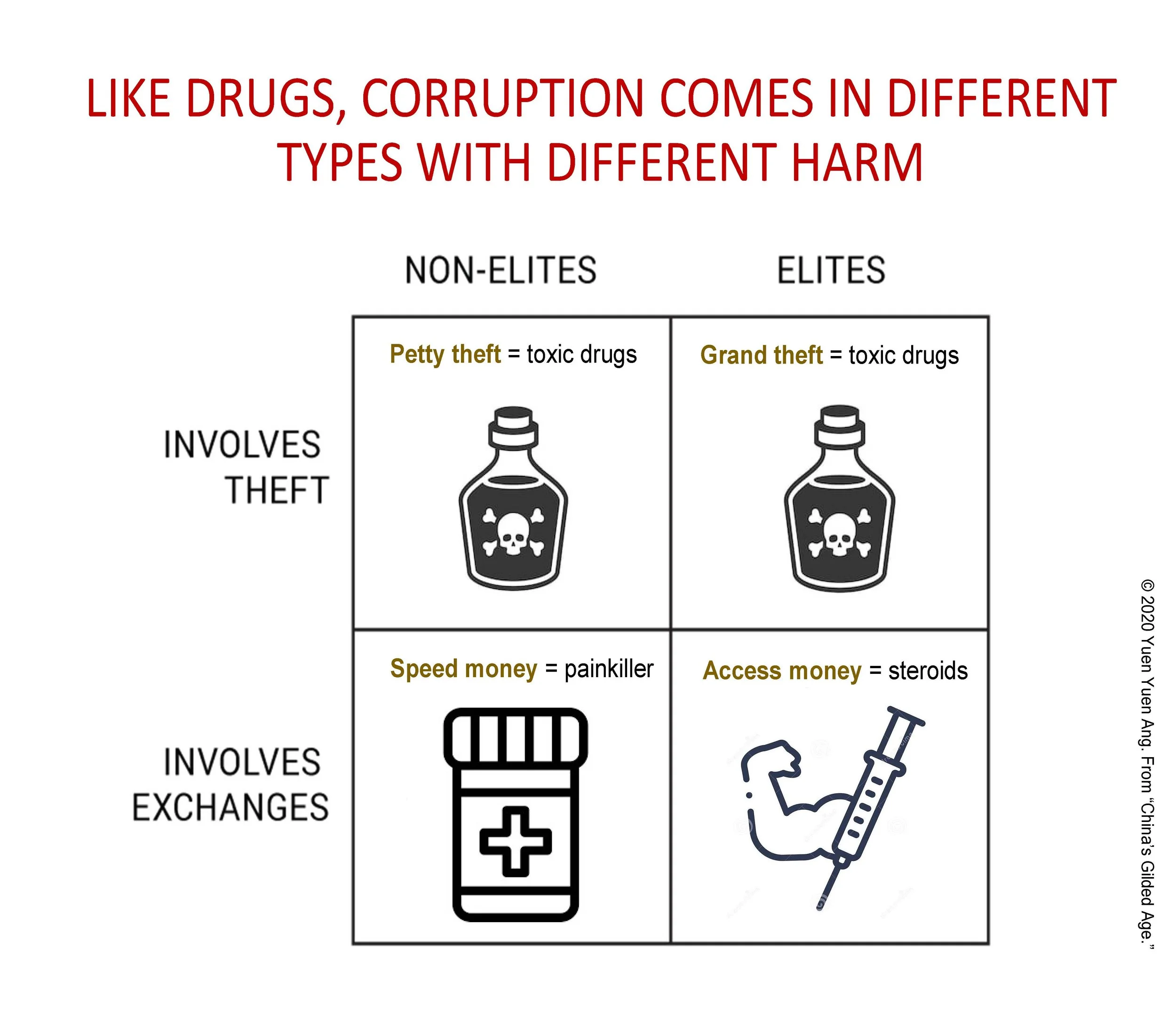
Image: “Unbundling Corruption,” by Yuen Yuen Ang (2020)